


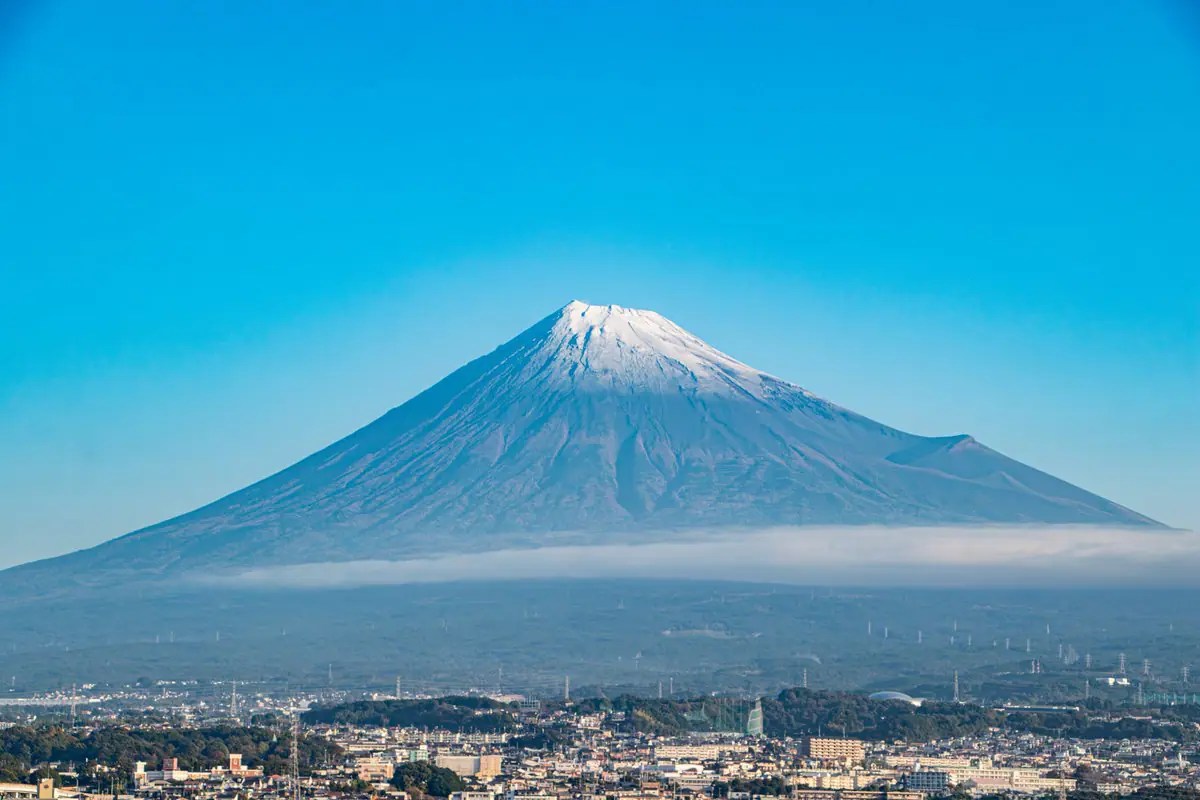
This year, a Japanese tradition dating back to 1894 has come to an end. Since the year the First Sino-Japanese War broke out, a small weather station in Kofu, a city about 105km (65 miles) west of downtown Tokyo, has tracked the beginning of Japanese winter in a somewhat peculiar way.
Every year, as autumn drew closer to winter, meteorologists in Kofu would wait for word of potential snow clouds moving toward Japan’s highest summit, Mount Fuji, 3,776 meters (12,389 feet). When news arrived that the mountain could see its first snow of the season, an observer would climb to the roof of the weather station at 6 a.m. and simply look for a snowcapped peak.
If no white was seen, be it due to no snow falling at night, clouds blocking Kofu’s line of sight, or accumulation too scarce to be seen with the naked eye, nothing would be announced. If, however, the elements cooperated and Mount Fuji’s snowy summit was visible across the Kofu Basin, the message would be broadcast throughout Japan.
The first sighting of snow on Mount Fuji was a tradition that signaled a changing of seasons in the country. A white Fuji meant that winter would soon take the place of a waning autumn.
Given its simplicity, the ritual had a few quirks. For instance, on November 6, 2024, Mount Fuji’s whitened summit was clearly visible from the Shizuoka side of the mountain. From Kofu, however, which sits on the opposite side, nothing was visible, as clouds shrouded the peak. Despite the observers’ best efforts, no sighting was made, and no announcement came until the clouds cleared the following day, even though snow had certainly fallen a day earlier.

Kofu’s inaccuracy is a major reason why the human observation practice, while steeped in tradition, is being replaced. In 2026, for the first time in over 130 years, the start of winter on Mount Fuji will not be measured by the naked eye, but by advanced meteorological technology.
The new system, which has been in operation since 2019, combines weather radar with data from AMeDAS, Japan’s nationwide network of automated weather stations, to estimate snow depth at Mount Fuji’s summit. Over the past several years, as the data set has grown, the method has become reliable enough to be deemed an adequate replacement for the unreliable, yet beloved, practice of human observation.
Now, Fuji’s first snowcap will be recorded when the system estimates that at least 1cm (0.4 inches) of snow has accumulated near the summit, regardless of time of day or visibility. This means the start of winter could be broadcast throughout Japan without a soul having laid eyes on a snowy Fuji — if, for example, snow falls during the night and melts by morning.
While the new system is no doubt more practical than relying on human observation, the change has faced mixed reviews. Mayor Shigeru Horiuchi of nearby Fujiyoshida said in a press conference that the new system “lacks feeling,” implying that the dawn of winter should be gauged not by a computer program, but by the sentiment of those actually experiencing the change of seasons. For many, it seems the coming of winter has little to do with a weather reading, and more to do with a human sense of beauty, poetically demonstrated by a simple observation for well over a century.
Shigehiro Tsuruhashi, a weather information officer at the Kofu station who served as an observer for Fuji’s first snow on several occasions, appears more neutral about the change. “In a word, it’s a sign of the times,” he told The Asahi Shimbun (2026), adding that more accurate analysis is undeniably a good thing.

Regardless of the mixed emotions surrounding the change, the new era will begin within the coming weeks. Fuji’s first snowcap of the 2026-27 season — now nearly three weeks late, as the mountain typically sees its first snow around October 2 — will be recorded not by an observer staring across the Kofu Basin, patiently awaiting the first sign of Japanese winter, but by an advanced weather analysis system, far more accurate than the tradition that came before it.


Do they not observe the Winter Solstice on Dec 21 in the northern hemisphere?