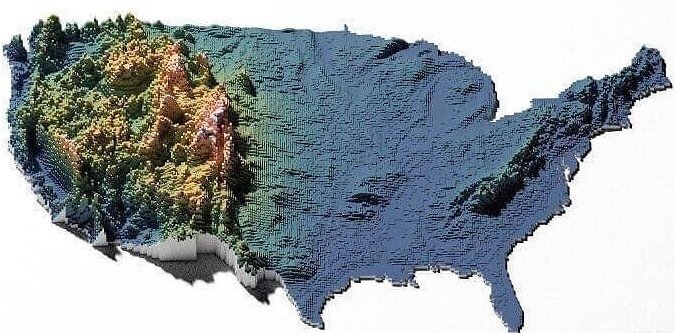
The United States is home to three major mountain systems that define much of its skiing and alpine identity: the Rocky Mountains, the Sierra Nevada, and the Appalachian Mountains. Looking at a topographic map of the country makes their scale and influence immediately obvious. It is one thing to know where the mountains are, but it is another to see just how dramatically they shape the elevation profile of the entire nation.
What stands out right away is how much of the western United States sits at a higher baseline elevation than the East. Vast portions of the West are elevated before you even begin climbing into true mountain terrain. That matters because elevation is one of the biggest drivers of snow reliability, colder temperatures, and ultimately ski quality. In broad terms, the higher the terrain, the better the odds for snow to fall, stick around, and build into a deeper, more durable snowpack. That is a big part of why the American West has become the epicenter of big-mountain skiing, lift-served terrain, and expansive alpine recreation.

The contrast with the eastern half of the country is striking. While the Appalachians are an ancient and beautiful range with a deeply rooted ski culture of their own, they simply do not have the same elevation, vertical scale, or widespread alpine exposure as the mountains out West. The East is not without serious terrain, but on a continental scale, it is easy to see why Western mountains dominate the conversation when it comes to snowfall, high-alpine access, and terrain size.
Of course, those three headline ranges are only part of the story. The United States is filled with important subranges and standalone mountain systems that are hugely influential in their own right. The Cascade Range in Washington, Oregon, and northern California is one of the snowiest mountain belts in the world and plays a major role in North American ski culture. Farther north, the Alaska Range brings an entirely different scale, home to some of the continent’s most dramatic relief and wildest ski terrain. Even the Rocky Mountains themselves are not one single uniform chain, but rather a vast system made up of roughly 100 distinct mountain ranges, each with its own character, climate, and skiing style.
In short, this map does more than show elevation. It helps explain why skiing in the United States looks the way it does. From the massive high country of the West to the lower, older mountains of the East, the geography of the country has shaped its ski culture from the very beginning.

Captain Obvious:
You Sire have captured the obvious. Without a doubt.
đŸ˜‰
You must have done extensive research for this highly technical “article”. The quantitative data is most impressive!